Showing posts with label Holy. Show all posts

Tuesday, January 21, 2014

Year A - Seventh Sunday after Epiphany, Seventh Sunday in Ordinary Time (February 23, 2014)

Leviticus 19:1-2, 9-18

* At the beginning of the service, identify HOLY as the word of the day and challenge children to count the number of times it is used in worship.  Hear their counts as they leave the sanctuary and congratulate them on their effort.

* Unlike the NRSV, Today’s English Version (The Good News Bible) does not assume that the reader knows about gleaning and other old practices.  That makes it easier for children to follow.

* Invite the congregation to join in reading the scripture by saying the “I am the Lord” phrase each time it appears.  Print the text in the bulletin and explain the meaning of the phrase in this context before reading together. 

++++++++++++++++++++++++++++++++++++++++++++++++++++++

Leviticus 19:1-2, 9-18

Leader:         The Lord told Moses to say to the community
                            of Israel,
Be holy, because I, the Lord your God, am holy. 
When you harvest your fields,
     do not cut the corn at the edges of the fields,
     and do not go back to cut the ears of corn
          that were left. 
Do not go back through your vineyard
     to gather the grapes that were missed
     or to pick up the grapes that have fallen;
     leave them for poor people and foreigners.

All:                 I am the Lord your God.

Leader:         Do not steal or cheat or lie.
Do not make a promise in my name if you do not
           intend to keep it;
that brings disgrace on my name.

All:                 I am the Lord your God.

Leader:         Do not take advantage of anyone or rob him.
Do not hold back the wages of someone you have
      hired, not even for one night. 
Do not curse a deaf man or
      put something in front of a blind man so as
to make him stumble over it.
Obey me;

All:                 I am the Lord your God.

Leader:         Be honest and just when you make decisions
                              in legal cases;
       do not show favouritism to the poor
             or fear the rich. 
Do not spread lies about anyone, and
when someone is on trial for his life,
       speak out if your testimony can help him.

All:                 I am the Lord.

Leader:         Do not bear a grudge against anyone,
       but settle your differences with him,
so that you will not commit a sin because of him.
Do not take revenge on anyone or continue
           to hate him,
but love your neighbour as you love yourself.

All:                 I am the Lord.

                                                                              Today’s English Version

++++++++++++++++++++++++++++++++++++++++++++++++++++++

BE HOLY

* Most children are told (and want) to be cool, smart, happy, good…   But Moses is calling them to be “holy.”   Most of them have no real idea of what that means.  Some may connect “holy” with extra good, maybe even overly good people and therefore do not want to make it a goal for themselves.  They will need help defining the word.

One starting point is the way the word is used to describe God.  If the word appears anywhere in the sanctuary, point it out.  Look at the Holy of Holy Bible.  Consider starting worship by singing “Holy, Holy, Holy” and then talking about what we sang about God. 

Next work with the fact that we are made in God’s image and are meant to be as like God as we can be.  That means we are supposed to be holy.  The specific commands in the text provide examples of what God does and calls us to do.

Or, point out that holy means set aside for God.  Just as the Bible, the communion table, etc are set aside for the service of God, we are also set aside to be God’s people.  That means we are holy.  At our baptism we are set aside for God. 

* To explore how we are set aside for God at our baptism and thus holy, select a few key phrases from your congregation’s ritual.  For me, it would be “you are Christ’s forever” and maybe “do you renounce evil.”  Talk briefly about what each phrase says about how we live every day at school and how we treat other people. 

* Side bar:  Many children hear the word holy most often in expletives -  holy smoke, holy mackerel, holy cow, and probably a number of phrases you’d rather not utter in the sanctuary, but which one of the children will say if given a chance.  It is possible to note these phrases illustrating with a few of your choice, then point out that they make no sense at all.  They are simply things we say when we are so frustrated or angry that we have to say something flashy.  Rather than use holy which refers to God to do this, we can use other words.  Some children make up long twisted words or phrases like “horseradish pickles.”  A case can be made that using holy in this way is misusing God’s name.  This is definitely a side bar and not the heart of today’s worship themes.

 
Psalm 119:33-40

* This is the second of the Psalm 119 readings.  It continues the alphabet poem with today’s verses starting with the Hebrew letter “he.”  If you did not introduce all the synonyms for Law in Psalm 119 last week, go to Epiphany 6 (Yr A) 6 for an idea about doing so this week.

* All the lines of this section start with a verb asking God’s help in living by the Law, or for today’s purposes asking for help in being holy.  After reading the lines the poet offers, make up some of your own and challenge worshipers to create lines of their own, e.g.
Teach me how to tell the truth – all the time
Show me how to be a good big brother
Remind me to be kind even to people who are not kind to me


1 Corinthians 3:10-11, 16-23

* The “you” in this passage is the church not any individual.  The church is God’s temple, where God is present and known.  The writer is exploring the value of the church and the responsibility of leaders and members to care for it, protect it, even keep it “holy” (tying into the Leviticus reading).  Children are ready to hear this message, but will not be able to find it from the text as it is read.  Instead, they will depend on worship leaders to identify and explore the theme.

* As background for the text, identify leaders in your congregation. 

Identify the elected leaders and give a brief child-friendly description of their responsibilities.  Ask those who fill those offices to stand so the children and others can see them. 

In addition, identify some of the unelected leaders.  Name some people who take care of the church by quietly doing specific jobs, e.g. people who set up the sanctuary for worship, people who take a turn in the church nursery, people who maintain the church’s library or kitchen, or anyone else who does work that cares for the church. 

* If you pray for the leaders of your congregation, be as specific as possible.  Name the offices and pray about the work of those in that office.  Though you may not want to name names of unelected leaders you can pray for those who do very specific tasks.

Thank you God for the people who work so hard on the worship planning team to provide prayers and songs and readings that guide all of us every day. 

God, be with the deacons as they visit people who are sick and sad and lonely.  Help them find the words to say that will remind people how much you love them and how much we love them.  Keep them safe as they deliver food and run errands for people.

* Use the finger-play “Here is the church, Here is the steeple, Open the doors to see all the people.”  The second verse (with fingers on the outside instead of inside) is “You can have a church, and not have a steeple, But you can’t have a church without any people.”  After demonstrating the finger play and inviting everyone to go through it with you, keep your fingers up and wiggling.  Announce that today we are thinking about the fingers, the people of the church, that is us.  Point out that every one of us is responsible for the care and protection of the church. 

* Sing about the church

Ask a children’s choir or class to sing “We Are the Church” by Avery and Marsh.
Scroll down on this page to We Are the Church to see the words and tune from the Methodist Hymnal.
 
 Sing “God of Grace and God of Glory” as a prayer for the church.  To challenge children to sing every “grant us wisdom, grant us courage” in the refrains, even if they can’t keep up with all the verses because we the church really do need wisdom and courage to be the church everyday. 


Matthew 5:38-48
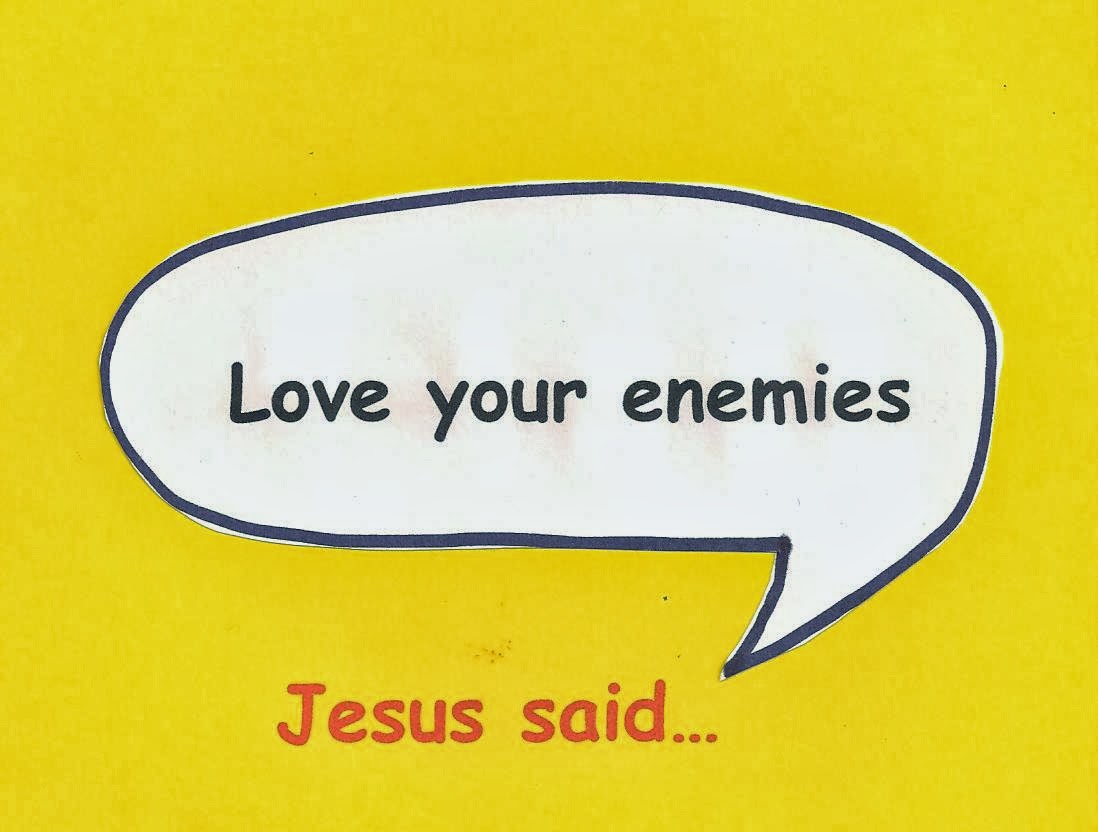

* Today’s “Jesus said” poster is obvious.  “Love your enemies.”  As you add it to the other posters or put it on display admit that it may be the hardest thing Jesus ever said.
 

* “Love you enemies.”  Love here is a verb that means treat with respect.  To most children love is a feeling or the way you act when you feel good about someone.  Jesus’ teaching is that we should treat everyone, even people who are not nice to us, with respect.  We must remember that no matter how they are treating us, they are God’s children and we need to treat them with respect.  This takes some explaining!

* Several stories in which children refuse to participate in revenge are worthy sermon illustrations.


The Story of Ruby Bridges, by Robert Coles, tells the true story of a seven year old African American girl who was escorted to school every day for months by federal marshals through angry yelling white crowds as schools were desegregated in the American south.  Each day she prayed asking God to forgive the people who were yelling at her.  Children may have heard this story during Black History month at school as an example of how hard it was to end segregation.  Revisit the story in worship as an example of a girl who chose to forgive rather than retaliate.  Check this out from the public library if it available – it is Black History month.

The Christmas Menorahs: How A Town Fought Hate, by Janice Cohn, is too long to read in worship (40 pages).  Read it in advance and tell the story in your own words during the sermon.  A hate group threw a rock through the bedroom window of a Jewish boy in Billings, Montana.  There was a menorah lit in the window.  In response the children of the town drew menorahs to put in their own windows.  The local newspaper printed a full page menorah for other families to color in.  It was the community’s way of standing up to a bunch of bullies.  The book includes the legend about the King of Denmark wearing a yellow star when the occupying Nazis decreed that all Jews must wear a yellow star.  Available in many public libraries.

Enemy Pie, by Derek Munson, is a picture book describing how Dad helped his son get rid of a neighborhood enemy by baking an enemy pie.  The secret ingredient in the pie was that the son had to spend the entire afternoon with his enemy being nice to him.  Of course the enemy was dispatched by becoming a friend.  The story could be told briefly in your own words during the sermon or could be read in its entirety in 10 minutes.  While it is a bit simplistic, the story teaches a clear message and is enjoyed by listeners of all ages.  Though the story is not widely familiar, I found several copies in the local public library.

* If the children are sitting near you, hold out your hand and ask the child to slap your hand.  After the slap act surprised and say, “You slapped me!  I owe you one.”   Then insist that the child hold out his or her hand.  Gently slap it.  Then say, “Oh no!  Now you owe me a slap.” and offer your hand.  Continue for several rounds.  Then, stop yourself before you slap the child’s hand.  “This could go on forever.”  Announce that you are owed a chance to slap, but you are not going to take it.  It is the only way you can stop the slapping.  Thank the child who slapped with you.  Then, note to everyone that this was a rather silly demonstration of something serious we face all the time.  If someone hurts us, we want to hurt them back.  If they call us a name, we call them one back.  If someone breaks something of ours, we want to break something of theirs.  If someone slaps or hits or kicks, we want to slap or hit or kick back.  The problem with that is that everyone forgets who started it and keeps on hurting each other.  Jesus tells us we have the power to stop all the hurting.  Even if we deserve a chance to hit or kick or call names back when someone hurts us, we can refuse.  It is one of the hardest things Jesus asks us to do.  Note briefly that this doesn’t mean we should let anyone who wants to hurt us do so any way they can at any time they want.  What Jesus says is that we should find another way to get things straightened out.  Lots of time we need help to figure out that way.  Jesus knows that and urges us to get all the help we can, but not to hit, slap, kick, hurt back. 

* Sing about loving enemies

Before singing the The Servant Song (“Brother, sister, let me serve you…”), give worshipers a moment to make a silent list of the people it is really hard to get along with.  Then challenge them to sing the song for those people.  Even read the first verse and point out that it is also the last verse – and not easy to sing/pray for the people on our lists.

There are two verses in Carolyn Winfrey Gillette’s hymn “Up On a Mountaintop”  (words at Up On a Mountaintop) that fit these verses especially well.  Take time to read them and illustrate them with everyday child or household situations before inviting worshipers to sing the whole song.

If any hurt you, then you may resist,
But not with hatred or weapon or fist.
God's way is stronger than any you face;
Stand up and love them! And give them God's grace.
Love those who hate you and pray for them, too.
God's mercy reaches out far beyond you.
Seek, as God's people, God's wholeness each day
So you can witness to God's perfect way.

Monday, February 18, 2013

Year C - The Fifth Sunday in Lent (March 17, 2013)


Today’s texts share themes of gift giving.  Isaiah speaks of God’s gifts and action in the world.  Paul evaluates several of God’s gifts to him and declares God’s love in Jesus so wonderful that Paul responds with giving back to God.  Mary and Martha both give loving gifts to Jesus.  All of these gifts point to the biggest gift that will be celebrated as Holy Week starts next Sunday.


U  If you have been presenting a different heart each Sunday of Lent, today’s heart is a gift.  It could be a heart shaped gift box or a heart wrapped with a ribbon.  Either one connects to the loving gifts that Paul and Mary gave in today’s texts and reminds us of Jesus’ gift of forgiving love on the cross.  It also calls us to think about the gifts we give God and give people for God.  Present it at the Call to Worship challenging worshipers to watch for gifts in today’s worship and to think about gifts God gives them and they might give God.  Display it prominently for the rest of the service.

U  The petition “hallowed be thy name” in the Lord’s Prayer underlies both Mary’s lavish gift and Paul’s total commitment to Jesus.  Both give and live as they do because they know God/Jesus is hallowed.  Unfortunately, few children know the word hallowed.  So before they can pray the prayer with understanding they need to learn that hallowed is another word for holy and explore the meaning of that word.  Try some of the following:

Define words such as awesome, special, and wonderful.  Hear some of the people and things to which each can be applied.  Then introduce the words holy and hallowed.  Explain that they mean the same thing. Define them as the very, very, very best and insist that they can be applied only to God.  Then translate the prayer, “God you are holy, the very best there is in the whole universe.”

Sing “Holy, Holy, Holy.”  Children will not understand all the images in the verses, but they can be challenged to sing “holy, holy, holy” each time it appears.  Call on parents to help the youngest readers by pointing with their finger or giving a little nudge each time you sing the phrase.

If you celebrate Communion today and will sing a Sanctus together as part of the Great Prayer of Thanksgiving, point it out just before the communion liturgy.  Practice it and put it into your own words.  Then, invite worshipers to listen for it and to imagine themselves joining everyone who ever lived, lives now, and is already in heaven in saying together that God is holy.  

If the word holy is carved into the Table, written in glass windows, stitched into banners or paraments, or displayed in other ways in your sanctuary, point it out and briefly say what it means.

Immediately after any of these discussions, pray together only the beginning of the Lord’s Prayer, “Our father who art in heaven, hallowed be thy name.”

U  Mary’s gift and Paul’s statement are their ways of answering the question “what is most important in the world to you?”  Mary either used her most special possession to show Jesus how important he was to her or she took most of the money she had to buy the special anointing oil for him.  Paul insisted that though he had been and done some really cool things, none of them was as important as knowing God.  He became a preacher and missionary because knowing God was the most important thing to him and he thought that was what God wanted him to do.  While children cannot grasp the full impact of the question, they can be taught early that it is an important question and that told they will have to live out their answers to it throughout their lives.
 
Isaiah 43:16-21

U  Children for whom everything is new do not get too excited about Isaiah’s vision of God doing “a new thing.”  So,

explore these verses today as a look ahead to the Holy Week stories.  Remind the children of the bad part when Jesus was whipped and killed and the good part when he was alive again.  Note that God was doing a new thing in both the bad and the good parts of the story.  Invite the children to come walk through that story during Holy Week.

Or, look behind the promise of God doing a new thing to the belief that God is always at work in the world and in our lives every day.  Invite the children forward for the reading of this text.  Begin by telling them the back story.  God’s people had been captured and taken away as prisoners of war.  Years later when the king said they could go back home they were so very happy.  They were sure God was working with them on this.  When they got back home they found their old town in ruins.  It was like a desert.  Finding food and even water was hard.  But, even then they believed God was with them and working with them in the hard times as well as the good ones.  Finally, read the passage dramatically before sending the children back to their seats.

U  If this passage is the focus of worship today, you might want to explore with the children ways we work with God on bringing water to dry places.  If your congregation has a well digging project or if your Lenten offering supports water missions, talk about them today. 

Psalm 126

If you told the back story to the Isaiah text, children can follow the psalm a little bit when it is presented as the prayer of God’s people as they were both happy to be back home and sad about how hard life was there.  Have half of the congregation read verses 1-3 to celebrate the happiness and the other half read verses 4-7 to remember that God was still with them in the hard times.


Philippians 3:4b-14

U  Avoid adult sqeamishness about using certain forbidden four letter words for excrement by using a child’s acceptable and clear four letter word –  poop.  Paul says his impressive life resume isn’t worth poop when compared to God’s love for him.

U  Even though some of their parents are obsessing about building resumes for them that will get them into college, most children are not too impressed with resumes in general or Paul’s resume in particular.  But, they can understand that Paul thought he was and had done a lot of good stuff and that the very most important thing in his life was God and doing the job God had given him.  In a conversation make a list of things children value being and doing (riding a bike, being on a travel sports team, playing a musical instrument, getting more than halfway through their current grade in school, etc.).  Then, insist that knowing God and doing what God made them to do is more important than any of those things – wonderful though they be.

U  Since today is St. Patrick’s Day, tell Patrick’s story connecting it to Paul’s story and claim that he gave up much to be Christ’s person and was glad to do so.  Patrick’s story is simply that he was kidnapped from his noble home in Britain as a child and taken as a slave to Ireland.  After 6 miserable years, he escaped and made his way back home.  Later he had a dream in which God told him to go preach in Ireland.  He did and became patron saint of Ireland.  Patrick, Patron Saint of Ireland, by Tomie dePaola, tells the story and several of the legends about Patrick.  The book is too long to read in worship, but can enable a worship leader to tell the story in his or her own words and offers some beautiful art of St. Patrick.  The book is available in many public libraries.  If you cannot get it, learn about Patrick on Wikipedia or some other source.

U  Sing “Take My Life and Let It Be” with all its references to using the parts of our bodies to give gifts to God or “Lord, I Want to be a Christian” to recommit yourselves to loving God like Paul did.

John 12:1-8

U  Before reading this story point out to the children that this Mary is not Jesus’ mother but another Mary who was his friend.  Enjoy the fact that there were lots of girls named Mary then, just as there are lots of girls named Mary today.


For the sake of the boys, choose
one with a not too sweet smell.

U  John says the smell of Mary’s gift filled the house.  So just before reading the story or at the beginning of a sermon focused on the story, squirt small dabs of lotion into the hands of children or all worshipers.  (If children are likely to be wearing open shoes, they could rub the lotion on their feet.  In colder climates they can rub the lotion into their hands.)  Rub some into your own hands.  Sniff them and enjoy the smell.  Challenge worshipers to try to catch the smell of the lotion in the whole room.
 
If you use incense in worship, cense the room before reading the gospel noting as you do the verse about the smell filling the whole house and maybe talking about why you use incense in worship.  (I don’t know much about this and would love to hear about possible connections from someone who does.)

My drawing.  Feel free to print it or create one of your own.
 
U Mary’s gift gets all the attention here.  But, John also notes that Martha prepared a meal for Jesus.  That was a gift too.  Challenge children to think of a gift they can give God between now and Easter.  List some possibilities such as a money contribution to a mission project or something they can do to love a person who needs loving right now.  Give them paper and crayons with which to draw or write about their gift.  Invite them to place their drawing in the offering plate as it is passed.

U  Children appreciate that Jesus defended Mary’s gift when Judas made fun of it.  On a day when we are thinking about Mary’s gift, Paul’s gift, and our own it is good to be reminded that Jesus values all our gifts. 

Friday, October 5, 2012

Year B - Proper 24, 29th Sunday in Ordinary Time, 21st Sunday after Pentecost (October 21, 2012)


Children's Sabbath Logo
F This is the official Children’s Sabbath Weekend.  Go to Children's Sabbath on this blog for general ideas about celebrating this event and a link to the massive Children's Sabbath manual.  Today’s texts offer fine connections to it for adults, but are a little harder to use as connections with children.  Two possibilities:

1. Invite children to illustrate Psalm 104 or one of the creation hymns.  Use their illustrations on the cover and/or in the margins of the printed order of worship.

2. Describe ministries in which your congregation acts as servants to children in need, e.g. one local church packs small bags of food to send home on Fridays with children who depend on school meals for food and would probably go hungry on the weekend without these stashes.


Job 38:1-7, (34-41)

F Before reading today’s text from Job, review the story to date.  Read verses 1-3 pausing to restate the situation and point out that the rest of the reading is a list of questions God asks Job.  As you read emphasize the question words - who, where, how, etc. and pause briefly between each question to separate them. 

It would be possible to have the questions read by an invisible reader over the sound system.  A booming male voice would keep with the dramatic style of this story.  But, a motherly "let's talk about this" voice might be an interesting alternative.  Whichever voice is used, it will suggest to literal listeners that God speaks in a loud disembodied voice.  So, if you do this, be sure to address the possible misunderstanding immediately after the reading.

F Focus on all the questions.  Pause after reading each one to put it into your own words.  Ponder together what God wants Job to think about.  Point out that sometimes we think we are smart and have everything figured out, but we don’t.  God is bigger than anything we can even imagine.

F “Immortal, Invisible, God Only Wise” is packed with impossibly long words used to describe God who is more than anything we can image.  So before singing the hymn together, invite worshipers to follow along in their hymnals as you read through it savoring selected words with brief comments.  For example, “Immortal – that means God was never born and never dies.  God always was and always will be.  Invisible – we can’t see God.  God only wise.  Only God knows and understands everything completely….”  Don’t get bogged down in any one phrase.  The point is to paint a picture of God as more than we can imagine.  Once you have read through all the verses, invite worshipers to sing to this amazing God.

Look below in the resources for Psalm 104 for more child-friendly hymns praising God the creator who spoke to Job.

F Highlight the opening of the Lord’s Prayer – “Our Father, hallowed be thy name.”  Define the word “Hallowed” with reference to the questions God asked Job.  God is different from any other being in the universe.  God made everything and understands everything and loves everything.  If the word Holy is carved or stitched into the front of your sanctuary, point it out and connect it to the word “hallowed.”  If you sing “Holy Holy, Holy” today connect those “holy”s to this “hallowed”.  Pray the Lord’s Prayer together immediately after this discussion.

F Possibility:  Add Job’s response to God in Job 48:1-6 to today’s reading to complete the conversation.  When we do that we (and children who don’t remember much from one week to the next) hear immediately that Job understood God’s questions and got God’s point.  Job admits that he is human and not God.  He also appreciates that God heard his questions and accepted them.  Going forward God and Job can talk honestly about whatever is important to them AND Job knows that God is always God and will always be more than Job can fully understand. 

If you do this, consider reading Psalm 8, possibly using the script offered last week at Proper 22 (Year B).  It focuses less on the Creator and more on the relationship between the Creator and people.

F This is the third reading in a lectionary series.  If you have not read the earlier posts go to Proper 22 (Year B) and Proper 23 (Year B)  for more ideas related to exploring Job in congregations that include children.


Psalm 104:1-9, 24,35c

F In the NRSV almost every line begins with the word YOU.  Before reading the psalm, point this out and note that the YOU is God.  The psalm writer is talking to God.  Encourage children to listen for all the YOUs to learn what the psalmist was saying to God. 

F Creation, by Gerald McDermott, is a beautiful picture book based on the first chapters of Genesis.  It can be read aloud in about 3 minutes.  With a smaller group of children seated together, I would read the book aloud and expect to be interrupted as children point out some of the creations they see.  If you use projections, consider buying a copy of the book to scan and show as it is read.  (If you do not share your scan with anyone else, I am told this not copyright infringement.)  The last page of the book says “I am all this.  ALL THIS I AM.” which is a good connection to what God said to Job.

F Child friendly hymns praising the God of creation and connecting to Job include:

“I Sing the Almighty Power of God”
“All Things Bright and Beautiful”
Both of the above praise the creator who by rights can ask Job the questions God does.  Job could have sung either after his encounter with God.

“Earth and All Stars”
Describes the partnership between God the creator of all and we humans who are created in God’s image.  The repeated chorus can be sung by even non-readers.


Isaiah 53:4-12

This is a very complex passage for adults to read and understand.  It is filled with vocabulary and ideas that are unfamiliar to most children.  If you read it hoping the children will understand at all, try the Good News Bible translation which at least uses words children recognize.  Or read it from another translation mainly for the adults.


Psalm 91:9-16

F This is a tough psalm for adults who are aware of Job-like suffering all around them to understand and almost impossible for literal thinking children to grasp.  I’d skip it today given the other texts.

F Go to 26th Sunday in Ordinary Time (Year C) for ideas for singing 3 hymns that carry message of this psalm better that the psalm itself does.


Hebrews 5:1-10

F This letter is written to the Hebrews, people who knew exactly what a priest was and did.  They understood the writer’s message immediately.  It made deep sense to them.  But, High Priest is not the best name with which to describe Jesus to today’s children.  For them a priest is what you call the staff  leader in some Christian denominations.  Still, some older elementary school children are interested in what the ancient priest did and can hear how Jesus is like that priest.  But, they need a detailed explanation of those priests and the sacrificial worship they led.  Even then, they have trouble.  The practice of killing an animal to tell God you are sorry does not make sense to them.  They can’t imagine that God would be pleased by that or that God would require that in order to forgive us.  The only way to present it is as something people used to think that we now think differently.  Compare it to the fact that people used to think the earth was a flat pancake, but we now think it is round ball. 


U HIGH PRIEST U

F After exploring what a high priest is and does, add the title High Priest to your Hebrews poster of words about Jesus.  Draw a cross at the beginning and end of the word.


Mark 10:35-45

F This is a good story for a children’s class to pantomime as it is read or to present as a play.  Jesus sits in the middle of the chancel.  James and John approach from one side.  The liturgist acts as the narrator.  The “other disciples” could be imaginary or could provide roles for a bunch of children so that there is a role for all in the class.

F Where you sit at the table is important to children.  They want desperately to sit near Grandma when she visits, to not be the one who has to sit on the piano bench or at a kid’s table when company comes, and to not have to sit with “them” at lunch at school.  They know that the other disciples were not so much shocked at James’ and John’s request, but they were upset that those two got their request in first.

F This story asks us to explore what it means to be a leader.  Children want to be the line leader, the class president, the team captain, etc.  Leadership is presented to them from an early age as being desirable.  It brings honor, titles, and special privileges.  Jesus has a different definition.  Jesus agrees that it is good to be a leaders but says that a leader is a person who puts the needs and wants of others before his or her own.  Children struggle with this difference in definition.

Much time is spent by coaches of children’s sports teams teaching them to play as a team.  It is hard for children to learn the value of passing the ball so another player can score rather than holding on to the ball desperately trying to make the score on their own.  Leaders are people who give up their own glory for the good of the team.

F God Said Amen, by Rabbi Sandy Sasso, tells of two kingdoms one with water but no oil and the other with oil but no water.  Unfortunately, the rulers of the two are so intent on being the first to be approached by the other that nothing happens.  They finally turn into stone mountains while they wait for the other to make the first move toward sharing.  Two children looking for the missing rulers find each other and work out a sharing deal that benefits all. They are real leaders who are willing to look for answers in new places.  It takes 10 minutes to read aloud.  For a shorter presentation select one or two pictures of the stubborn Prince and Princess to show as you tell the story of their leadership failure in your own words.

F Tell stories about leaders who have risked or suffered for others.  Tell about Martin Luther King who was killed by a person who did not like what he was saying, Nelson Mandela who spent 25 years in prison because he stood up to oppressive leaders in South Africa, Aung San Suu Kyi who spent 15 years in house arrest for standing up to oppressive leaders in Myanmar, etc. 

F I heard this supposedly true story about leadership attributed to Kenneth Bailey:  When King Hussein of Jordan was told that a group of young officers were at that moment meeting in their barracks to put final touches on a coup and was asked whether they should all be arrested and/or killed, his response was to order a small helicopter, fly to the roof of the barracks, tell the pilot to leave immediately if he heard gunfire, and then to go down the stairs and walk into the room where the officers were gathered.  He told them that if they did what they were planning, there would be civil war, chaos, and that hundreds maybe thousands would be killed.  Rather than risk that, he suggested that they shoot him now.  That way only one person would die.  The officers all knelt, kissed his robe, and re-swore loyalty to him.

F Songs about being a servant leader that children can sing:

“Brother sister let me serve you, let me be as Christ to you, …let me have the grace to let you be my servant too”

“Jesu, Fill Me with Your Love”