Showing posts with label Repent. Show all posts

Wednesday, August 14, 2013

Year C - Proper 19, 24th Sunday in Ordinary Time, 17th Sunday after Pentecost (September 15, 2013)


Fifty Years ago on the fifteenth of September men threw a bomb into the basement of the Sixteenth Street Baptist church in Birmingham, Alabama during the church school hour.   Four young African American girls were killed.  17 others were injured.  The girls were to participate in a Youth Sunday service built around the theme of forgiveness that day.  Congregations in Birmingham are working together to remember this event and use it to take further steps toward more justice among the races.  They invite congregations in other cities to do the same.  Amazingly, the lectionary texts for this day deal with repentance and forgiveness so there are many connections.  Go to 50th Anniversary of Birmingham, Alabama Church Bombing for my ideas about how to recall this event with children and links to lots of worship resources being gathered by the Birmingham churches.


These texts use and lead worship leaders to use a wide variety of sin and forgiveness words – sin, repent/ance, mercy, forgive/ness, pardon, grace, saved.  It is tempting to enrich the service by using as many as possible.  If you do, remember that many of them are unfamiliar to children.  So, select one or two familiar ones to explore in some depth or spend time introducing them as a group. 

N Write one or two on big posters to display during the whole service.  Before the call to worship, introduce the word/s with brief definitions.  Give children stickers or marking pens with which to note in their bulletin every time they hear, sing or pray the word/s. 

N Select two or three words to present as a word family defining each word and telling how it is related to the others.  For example, SIN is all the bad stuff we do.  REPENTANCE is deciding to stop doing that stuff.  And, FORGIVENESS is God saying, “I’m glad you can see what you did wrong and are going to be different.  I’ll help you on that.”

N Use the word discipline rather than punishment to describe God’s response to sin and sinners.  Children hear punishment as getting back at the sinner or revenge.  With help they can hear discipline as helping sinners change their ways.
 
REPENTANCE is a key word today.  The usual understanding of repentance (especially among children) is that you say you are sorry and God or a person you have hurt forgives you, i.e. says that it’s OK.  In today’s stories repenting is more than that.  It is changing your ways.  Paul changes from killing Christians to being one of the biggest leaders of the Christians.  David asks God to help him change his ways, “create in me a clean heart.”  God decides not to abandon the Hebrew slaves in the desert, but to help them become the people God called them to be.  Jesus eats with “known sinners” because he believes they might change and calls on the Pharisees to do likewise.  Even children have trouble believing they or anyone can change.  “That is just the way she is.”  He’ll always….”  “I’ll never be …  I’m just too….” 

N Use your bodies in a prayer of confession and call to repentance.  While a worship leader prays aloud the prayer below, all members of the congregation stand to pray with their bodies.  Each time the worship leader prays “Great God, we are sinners,” everyone faces the back of the sanctuary.  Each time the worship leader prays “Turn us around,” everyone turns to face the front of the church. 


OLPNMOLPNMOLPNMOLPNMOLPNMOLP

Prayer of Confession and Call to Repentance

Great God, we are sinners.  We get everything wrong.  It is like we are facing the wrong way, dreaming the wrong dreams, working toward the wrong goals. 

Turn us around so that we face you, dream your dreams, work toward your goals.

Great God we are sinners.  Too often we are selfish grabbing the most food, the prettiest clothes, and the coolest games for ourselves.

Turn us around. Teach us to share what we have.  Give us generous hearts.

Great God, too often we think only of ourselves.  We think about we want, what we like, what we think.

Turn us around.  Teach us to see all the people around us.  Help us recognize what people in our families and our friends want and need and hope.  Help us learn to take care of them and their needs.

Great God, too often we hate.  We hate people who are not like us.  We hate people who make our lives even a little harder.  We hate people who get in our way.  We hate people we just do not like.

Turn us around.  Teach us that people who are not just like us are your children and worthy of our friendship.  Show us how to make friends with those who do not agree with us.

Great God, we are sinners.  We know it.  We admit it and want to change.

Turn us around to face you, to become your children, to be part of your kingdom.  

We bring our confessions of sin to you and ask for your help in turning around in Jesus’ name.  AMEN.


OLPNMOLPNMOLPNMOLPNMOLPNMOLP

 
 Maybe the best song for today is the second verse of “Jesus Loves Me.”

Jesus loves me when I’m good,
When I do the things I should.
Jesus love me when I’m bad,
Even though it makes him sad.


Jeremiah 4:11-12, 22-28

With all the other texts about sin and forgiveness today, leave this grim judgment one out.  Children are simply scared by it.  Also, because they take it literally, they often misinterpret it as God’s response to (or the natural consequences of) environmental sin.  It is not.  It is an indictment of national sins. 


Psalm 14

Given the choice of this general psalm and David’s story-based confession in Psalm 51, choose Psalm 51 for the children.  If you do read this psalm remember that to children “there is no God” translates “I’ll get away with it” or “It won’t matter” and that people who say those things are fools.  God knows and God cares.


Exodus 32:7-14

If you are exploring repentance today, this story becomes proof that even God repents or changes God’s mind.  When the people break Commandment #2 (Don’t worship idols) almost immediately after agreeing to keep it, God is really angry.  Moses talks God out of abandoning the people as hopeless sinners.  The fact that Moses would argue with God about this and that God would change the plan in response to Moses both impresses children and gives them the confidence to talk to God honestly about anything.  God can take whatever they have to say.  God will listen.  God may even change the plan.

The story of Jesus’ prayer in Gethsemane that did not get God to change the plan is a good balance to Moses’ story.  It proves that this is not a promise that God will change the plan to suit us every time we ask.


Psalm 51:1-10

N ”Create in me a clean heart, O God…” is a basic prayer that most Christians pray frequently in their lives.  David prayed it after he had stolen Bathsheba from her husband and had him murdered.  Paul might have prayed it after he realized how wrong he had been about Jesus and the Christians.  And, we need to pray at different times for different reasons.  Most children have little grasp of their own sinfulness.  They know they do the occasional bad thing, but are not overwhelmed by it.  Insist to them that this is a prayer they will need, practice saying it together and briefly explore its meaning. 

N Remember that children hear the poetic images in Psalm 51 literally.  So, “create in me a clean heart” sounds like “cut me open, take out my heart, scrub it down, and then stick it back in me.”  Ouch!  Point this out and then explore what it really means.  Describe how dirty and yucky we feel when know we have done things that are wrong and that have hurt other people.  We feel so rotten that we want to hide.  Then describe how clean and fresh and new we feel when we admit what we have done and do whatever we can to fix the hurt we have caused. 

N Use verses 1-4 and 10 as the prayer of confession for the day.  Before praying them, with the congregation (or children) identify all the sin words (sin, iniquity, transgression, and evil) in verses 1-4.  Have each word printed on a piece of poster board and display it in turn.  Briefly tell that David who first prayed this prayer had just had a man murdered so that he could marry his wife – that IS… list each of the words for sin!.  Note that most of us have not done anything that bad. Then, list specific examples of sin of which your worshipers might be guilty (lying to get out of trouble, saying mean words to or about someone, making another person’s life really unhappy by the way you treat him or her, being greedy, selfish, etc.)  Finally, read and explain verse 10.  Only, then invite the congregation to pray the prayer with you.

N The prayers of confession generally come early in worship.  It would be possible to pray them this week without comment at that time.  Then, pray them again after a sermon in which their meaning has been explored in detail.  During the sermon you might walk through that part of the liturgy explaining the sequence of confession, assurance, response, and passing the peace.  You might even practice sung or spoken responses.  Repeating the whole process after this explanation will give it more meaning today and help worshipers of all ages participate in it more fully in the future.


1 Timothy 1:12-17

N A little vocabulary thing:  Children will understand you if you speak of Paul “killing Christians” rather than “persecuting the church.”

N To make sense of this text, you have to know the story of Paul’s conversion (Acts 9:1-22).  Just before the epistle reading invite the children forward to hear you tell that story in your own words, then tell children that the epistle is the beginning of letter written by Paul years later. 

“Saul Learns About Jesus” from The Family Story Bible, by Ralph Milton, is one good telling of this story.  Use it as a guide or simply read it from the book.

N If you are focusing on God’s acceptance of all sinners, tell the story of Paul’s conversion paying extra attention to Ananias’ role and his willingness to believe that Paul could be OK.  “God, are you sure you have the right man?  I mean, this is Saul.  Saul, who is rounding up Christians and putting them in jail.  Are you sure you want me to bring him into my Christian home and heal him and introduce him to other Christians?”…”OK, I’ll give it a try.”


Luke 15:1-10

N Today’s gospel includes two separate but related parables.  To help young listeners hear each of them, have the passage read by three readers.  The usual reader reads verses 1-3.  Then a second reader reads the first parable (vss 4-7).  The usual reader adds “and he told another parable” after which a third reader reads verses 8-10.  The two guest readers might be a parent –child team, two older children, or two individuals of different ages.  F or visual appeal give the first reader a shepherd’s staff and the second a broom to hold as they read.  If these props are left near the pulpit, the preacher might pick them up when referring to that parable in the sermon.

N To get the feel of 100 sheep, count worshipers.  If there are more than 100 worshipers present, gather 100 people at the front of the sanctuary.  If the choir is in the front, start counting them then counting people coming forward from the congregation until you have 100.  Or, count people in their pews.  If there are fewer than 100 in the sanctuary, count the whole crowd and figure how many more you would need to make 100.  However you do this, enjoy how many 100 is.  Then wonder aloud what it would be like if you had to move around all day as group.  Imagine how easy it would be for one of you to be left behind.  Then send everyone back to their seats or simply announce that Jesus told a story about a shepherd who had 100 sheep.  Read it.

N Remember several things about being lost from a child’s point of view.  First, lost is being physically abandoned and alone.  Being lost in sin is a metaphor that requires explanation.  Second, fear of being lost (as in abandoned) is one of the deepest and most common fears of childhood - and most of life.  (Ever have dreams about being lost in an airport running to catch a plane?)  Third, when children are lost they assume that it is the adults around them who have wandered away from them.  They were doing reasonable to them activities and suddenly find themselves abandoned.  “I was looking at all the candy bars and mom was gone!”  “I decided to go back to the car while you shopped, but I couldn’t find it.”  So children assume the lost sheep was an innocent victim rather than a willful strayer – UNLESS you suggest the second possibility to them with examples of a sheep intentionally ignoring the shepherd’s call in order to chase a butterfly or eat more of a great patch of grass.

N The first decision worship leaders must make is who are the lost.  Most often readers assume that they are the lost ones sought out by God and celebrate God’s persistence in finding them.  But, Jesus told these stories to the Pharisees who were unhappy that Jesus was eating with known lost sinners.  His message to them is that God is more interested in the lost than in them – and they should be too. 

N To make Jesus’ point about reaching out to “the sinners,” read John Jewell’s story about church officer dressing as homeless man and sitting near door on Sunday morning then becoming part of the dialog sermon.  Or, reenact it with one of your officers.  Find it at The Man Who Slept on the Church Porch .

N Explore the idea that God cares for everyone, not just me and the people I like, but people I think are “sinners.”  How many people are at your school?  (Probably no one will know this, so move to the next question.)  How many in your class?  (Some will know or be willing to take a guess at this.)  Then do some math to see if there are ten classes at your school and ???? in each class, there must be about ???? children in your school.  That is a lot of people!  Add to that all the teachers, principles, cafeteria workers, custodians, bus drivers.  That is really a lot of people.  Now, I want to tell you something about every one of those people.  Jesus says God knows and loves every one of those people.  That of course includes each of you.  Nice, isn’t it?  No matter how good or bad the day is going, God knows YOU and keeps an eye on YOU and loves YOU.  That makes us feel safe and kind of special.  But try this, think of the meanest kid in the school.  God knows THAT KID and keeps an eye on THAT KID and loves THAT KID just as much as God loves you.  Think of the hardest teacher you ever had.  God knows THAT TEACHER and keeps an eye on THAT TEACHER and loves THAT TEACHER just as much as God loves you.  Amazing, isn’t it?  God loves the smarty pants kids, the stuck up kids, the grumpy adults, the pests, (add terms that are used in your area)...   Amazing!  And you know what else?  God wants us to know them and keep an eye on them and even LOVE them too.   Actually, God is counting on us to be God’s partners in this.  God thinks we are all one big family and wants us to be happy together.   Close with a prayer for all the people in our schools.

N Classic children’s picture books about being lost and being forgiven.
Runaway Bunny, by Margaret Wise Brown, is a conversation between a young bunny who asks his mother what she would do if he ran away from her in a variety of way and his mother who insists that she would always come after him.  At the end the little bunny decides he might as well stay home.

Mama Do You Love Me, by Barbara Joosse, is a similar conversation between an Inuit girl who asks her mother if she would still love her if she did all sorts of naughty things and her mother who replies to each that she would be sad or angry, but would still love her.

N Celebrate Jesus the Good Shepherd who comes after one lost sheep by singing your congregation’s favorite musical version of the Twenty-third Psalm.

Sunday, June 24, 2012

Year C - The Third Sunday of Advent (December 16, 2012)


''' Just a reminder: next Sunday is Mary, Elizabeth and the Magnificat.  I’d tend to read them today for several reasons: 1. December 23 feels too late to be telling that story in the Advent run up to Christmas, and 2. Mary and Elizabeth’s rejoicing is a good companion to all today’s other text’s calls for rejoicing.  Go to Year C - The Fourth Sunday of Advent for a reading script and other ideas about exploring this story with children.

''' The shared themes of the first three texts for this week speak more clearly to children than does any particular text.  So, I’m making thematic rather than scripture based suggestions for all except the gospel reading.

Lighting the Advent candle:

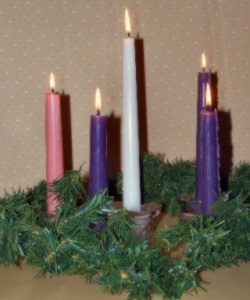
If you use a pink candle in the advent wreath, briefly explain that it is the joy candle.  (ASIDE:  The candle is NOT pink because we hoped it would be a girl as one wit suggested!)

Statement to read while lighting the candle: 

If focusing on rejoicing:  God, sometimes the world feels dark and evil.  We light a candle today to remind ourselves that you are with us every day and love us with a powerful love.  So, even when things are awful, we can rejoice.

OR

If focusing on Mary:  Mary sang,Rejoice in the Lord for God has done and is doing marvelous things!”  We light this candle for Mary and Elizabeth and to remind ourselves to be as ready as they were to join you at work in the world.


''' Today children can rejoice with the following festive, non-Christmasy songs:


“O Sing to the Lord!” includes three verses of simple, repeated words set to a Brazilian folk melody.  Children enjoy the addition of a trumpet interlude before the last verse, “dance for our God and blow all the trumpets.”  For extra exuberance add streamer twirlers when this song is sung as the processional or recessional.

Sing “Dona Nobis Pacem” as a round both at the call to worship before you explore the day’s theme and at the benediction reminding worshipers of what they now know about peace and joy.

And of course there is “I’ve Got a Joy, Joy, Joy Down in my Heart” with verses such as “I’ve got the peace that passes understanding way down in the depth of my heart.”

If you project songs to sing, try this Go Now in Peace as a benediction.

''' If you are ready for a Christmas carol, try “Joy to the  World!”  The words are too complex for children, but with direction they can get the first line of each verse.  Before the congregation sings the carol, have them follow along in their hymn books as you point out these opening lines somewhat as follows:

Why can we sing “Joy to the World”?
1.      No matter how bad things might be at the moment, “The Lord is come”, i.e. God is with us.
2.      The Savior, not any king or ruler or bully, is in charge of the world.   (Who is the savior?  Jesus is!)
3.      Given that, we don’t have to get upset in our sorrows or caught up in all the bad stuff that happens.
4.      And, like all good last verses, this one is the summary.  We can rejoice and sing “Joy to the World!” because God rules the world with truth and grace.

''' Jewish midrash includes several stories about how people responded to God’s dividing the sea for the slaves to walk through on dry land and then bringing it back together to drown pharoah’s army.  It seems some of the newly free slaves complained that walking through the sea was scary and hard.  They could only think about how tired and dirty they were.  But Miriam and others, who were also tired and dirty, danced and sang songs praising God for the incredible miracle they had just experienced and their new freedom.  After describing the situation, ask which group was “right.”  Of course, both were at different levels.  Then ask who they would rather travel into the wilderness with.  Younger children will not be able to follow this.  But older children can be drawn into the possibility of rejoicing being more a matter of one’s attitude toward what happens than what happens.  They can be helped by parallel examples  - maybe siblings who get similar sweaters from their grandparents.  One child is delighted and the other discards it as dumb.  (If you and the children talk easily on the steps, this could be a children’s time.  It could also draw older children into the real sermon if presented there.)

It might be fun and instructive to devote sermon time to imagining “not rejoicing responses” Mary, Joseph, the shepherds and others in the story might have had.  All of them chose to rejoice, but might have responded differently.  Then, there is the innkeeper who wavered between “I’m just too busy” and “you’re about to have a baby?!  The barn is all I have, but you’re welcome to use it.”  As you talk about each character, lift the appropriate figure from the creche.

''' Many congregations have become sensitive to people for whom it is hard to rejoice at this time of year.  Remember that this group includes children as well as adults.  Children face the same problems that daunt the adults, but do so with different twists.  For one thing, they lack the experience of many Christmases that the adults can draw on to keep a sense of balance.  For another, they feel that as a child they should be totally into the season.  It feels even more unfair to them than to the adults that they are not going to have special gifts or fun family gatherings or decorations or…..

''' If you have a Chrismons tree, help the children find ornaments that are stars or have stars in them.  Explain that stars are happy, rejoicing lights.  No one ever sees a star and says, “Rats! Who needs a star?”  Star stickers are used for decorations.  You never get a star sticker and a frowny face sticker on the same paper at school.  Recall, if a child doesn’t beat you to it, the star of Bethlehem.  Describe it as the happiest star ever and proof that God’s light was coming into the world. 

''' “Fear not!” is another shared theme of these texts.  But the fears alluded to are fears that I will not be enough, that I will not be able to handle it, that war or economic disasters will sweep me away, etc.  These fears are different from the fears children face in very subtle ways.  Facing them requires a different kind of courage and understanding of what is feared.  I think the fears that children face are better explored using other texts at other seasons of the year.  So, I’d tackle this theme with and for the adults. 


Luke 3:7-18

''' The RCL schedules verses 1-6 of Luke 3 for the second Sunday of Advent and verses 7-18 for the Third Sunday of Advent.  I (and lots of scholars!) think these verses really belong together.  So I’m suggesting reading them all on the second Sunday.  To accommodate this, I’d move the texts about Mary and Elizabeth to this week where it fits nicely with all the rejoicing in the other texts.  Go to Year C - The Fourth Sunday of Advent for ideas for Mary’s story.  But, just so you can find ideas where you look for the text I am reposting the ideas about the combined John the Baptist text that are also posted on the Second Sunday of Advent.  The ideas for the Mary and Elizabeth story are posted on the Fourth Sunday of Advent.

''' Combine the 2 readings about John’s ministry.  As you begin, point out that when John grew up huge crowds followed him.  Invite the congregation to join you in reading about John and those crowds.  Assign different sections of the congregation to be the crowds, tax-collectors, and soldiers.  The Narrator, who is probably the key liturgist, and John read from the front.  Everyone will need a script.  Prepare John to read dramatically as if addressing a large crowd out doors.

''''''''''''''''''''''''''''''''''''''''''''''''''''''''

Luke 3:2b -17


Narrator:  God spoke to Zechariah’s son John when he grew up.  John was living in the desert.  So John went along the Jordan Valley, telling the crowds of people who came there to hear him,


John:  Turn back to God and be baptized! Then your sins will be forgiven.

Narrator:  Isaiah the prophet wrote about John when he said,
“In the desert someone is shouting,
‘Get the road ready for the Lord!
Make a straight path for him.
Fill up every valley
and level every mountain and hill.
Straighten the crooked paths
and smooth out the rough roads.
Then everyone will see the saving power of God.’ ”

Narrator:  Crowds of people came out to be baptized, but John said to them,

John:  You bunch of snakes! Who warned you to run from the coming judgment?  Do something to show that you really have given up your sins. Don’t start saying that you belong to Abraham’s family. God can turn these stones into children for Abraham.  An ax is ready to cut the trees down at their roots. Any tree that doesn’t produce good fruit will be cut down and thrown into a fire.

Narrator:  The crowds asked John,

The crowds: What should we do?

John:  If you have two coats, give one to someone who doesn’t have any. If you have food, share it with someone else.

Narrator:  When tax collectors came to be baptized, they asked John,

Tax-collectors:  Teacher, what should we do?

John:  Don’t make people pay more than they owe.

Narrator:  Some soldiers asked him,

Soldiers:  And what about us? What do we have to do?”

John:  Don’t force people to pay money to make you leave them alone. Be satisfied with your pay.

Narrator:  Everyone became excited and wondered, “Could John be the Messiah?”  But John said,

John:  I am just baptizing with water. But someone more powerful is going to come, and I am not good enough even to untie his sandals.  He will baptize you with the Holy Spirit and with fire.  His threshing fork is in his hand, and he is ready to separate the wheat from the husks. He will store the wheat in his barn and burn the husks with a fire that never goes out.

Narrator:  This is the Word of the Lord!

Congregation:  Thanks be to God!

Based on the CEV

''''''''''''''''''''''''''''''''''''''''''''''''''''''''

''' Revel in all the specific places and people in the opening verses.  Get out a map – or better yet a globe.  Locate your congregation on it.  Point out the places.  They are all right around present day Palestine.  Together pronounce the names of the people and insist that these were real people that we read about in history books.  Luke’s point and yours to the children is this is a real story about real people in a real place.  Children who have trouble sorting out fiction from non-fiction appreciate knowing that.  They also enjoy Luke’s point that with the choice of all those important people living in important places, God gave his message to nobody John who lived in an unnamed wilderness. 

''' Remember that children will hear the poetry about roads and mountains literally unless you direct them otherwise.  In a day when mountain top removal is an environmental issue it is easy for children to jump to wrong conclusions.

'''  “Repent!” is John’s favorite word.  He used it lots!  To help children understand and claim the word, point out the difference in being sorry and repenting.  Being sorry is feeling bad that you did something wrong or hurt someone.  Repenting is doing something to make sure you never do that again.  Repenting is making changes in what we do.  It is much easier to feel sorry about something than to repent it.  John is not even a little interested in people feeling sorry about bad things they were doing.  He wanted them to change.  He would want the same for us this Advent.

After talking about repenting, challenge children to draw or write about repenting they plan to do in the coming weeks.  Invite them to put their art in the offering basket as a way of offering it to God and asking for God’s help.

''' To explore John’s call to repent and be baptized, explore the question “Do you renounce evil and turn toward Jesus Christ?” in many baptism and confirmation rituals.  To describe how we actually do this, sort a collection of cards or small posters into “evil” and “turn to Jesus” piles.  Write on each card something like Mine!, I want it!, Give me!  Me first! You stink!  May I help?  Can we share this? What would you like? You first!  I think you are special! Can we do this together?...  Briefly describe what working to say or not say each of these things is a way of keeping a promise to God. 

''' Sing your way toward repentance with “Lord, I Want to Be a Christian.”

Saturday, June 23, 2012

Year - The Second Sunday of Advent (December 9, 2012)


Today’s set readings include Zechariah’s song at John the Baptist’s birth and the beginning of his ministry.  Next week’s reading is John’s “what shall we do?” conversation with his listeners.  It would be possible to read all three today and to make John’s call to repentance the theme of the day.  If you do that, check the suggestions for Luke 3:1-17 in the Third Week of Advent.  Use the reading scripts from both weeks to present John’s long complicated story.  For ideas how this combination would affect texts for the rest of the season go to Planning for Advent and Christmas in 2012 - Year C.

'' Statement for lighting an Advent Wreath candle for repenting.  (Also check the suggestion related to today’s Philippians text for lighting this candle at the benediction.)

God, we know that we are not all you created us to be.  You call us to repent, to make changes.  So, we light this candle to promise you to make those changes.  Be with us, show us what to do, and give us the courage and energy we need to change.

The Texts

Malachi 3:1-4

'' If you read both Malachi and Luke, help worshipers find Malachi in their pew Bibles.  Point out that it is the last book in the Old Testament.  Then have worshipers find Luke 1.  With your finger in both places in a Bible point out that there was 400 years between Malachi and Luke.  During those years there were no prophets or special events.  It seemed like God had forgotten the people.  To give 400 years reality compare it to something familiar in your history, e.g. in the USA it has been less than 300 years since the Declaration of Independence and that seems a really long time ago.  Then, read the Malachi passage.  When you read Luke later begin, “remember what Malachi said?  Well, 400 years later….”

'' Malachi’s message is that God is not always sweet and gentle.  Sometimes God gets in our faces, insists that we change our ways, and calls us to take brave action.  Similarly, in The Lion, the Witch and the Wardrobe, by C.S. Lewis, when the children are told they will meet Aslan they are wisely concerned.  Malachi advises us to await God with the same caution.

“Is he a man?” asked Lucy.

“Aslan a man?” said Mr. Beaver sternly.  “Certainly not.  I tell you he is the King of the wood, and the son of the great Emperor-Beyond-the-Sea.  Don’t you know who is the King of Beasts?  Aslan is a lion, the Lion, the great Lion.

“Ooh” said Susan.  “I’d thought he was a man.  Is he - - quite safe?  I shall feel rather nervous about meeting a lion.”

“That you will dearie, and make no mistake,” said Mrs. Beaver, “if there’s anyone can appear before Aslan without their knees knocking, they’re either braver than most or else just silly.”

“Then, he isn’t safe?” said Lucy.

“Safe?” said Mr. Beaver.  “Don’t you hear what Mrs. Beaver tells you?  Who said anything about safe?  ‘Course he isn’t safe.  But, he’s good.  He’s the King, I tell you.”

(FYI – this conversation did not make the movie, so no need to go looking for the clip.)

'' Children have taken medicines that sting or taste bad to heal a disease.  Some have done exercises that hurt to rehab after a broken bone or sports injury.  And, all children are frequently reminded of the sometimes less than pleasant disciplines needed to succeed in sports or music.  These experiences, more than the refiners fire or the fuller’s soap, enable them to hear Malachi’s message that sometimes we must make hard changes and work hard to be the people God made us to be. 

To explain the refiner’s fire, show pictures of molten metal and briefly describe the process by which the rocky ore dug from the ground is turned into useful metal.

Remember that soap these days does not sting - even when you get it in your eyes.  So, point out that fuller’s soap is soap that is so strong in takes the color out of cloth and has to be used wearing rubber gloves since it raises blisters on skin.

'' During December many children are totally focused on being nice rather than naughty in order to get good gifts from Santa Claus.  They need to hear that Malachi and John the Baptist do not want them to be good in order to get gifts from God or so that God will like them.  The prophets want them to be good because God created them to be good.  They are to be their very best to show God appreciation for how God has made them.  There is no cute way to say this.  Straight talk is needed.  The medicine and discipline images above help communicate why we repent.

'' This is a good day to do some worship education about the prayers of confession.  Select a prayer that uses simple concrete words.  Before praying it, read it and summarize what it means to say those words to God.  Point to the assurance of forgiveness that follows.  If you follow this by passing the peace, explain that saying “Peace” to those around us is just the beginning.  We have to take that peace everywhere we go all week and share it with everyone we see.  That is not easy.  Admit that everyone in the congregation needs to pray this prayer every Sunday.


Baruch 5:1-9 or

During December the girls are often feeling like princesses wearing fancy Christmas dresses.  It is almost impossible to get them from thinking about those Christmas clothes to thinking about the prophet’s message.  Most boys are not interested enough in clothes to explore the prophet’s image.  So, I’d read this one for the adults.


Luke 1:68-79       The Song of Zechariah

'' The RCL suggests reading only the song of Zechariah today.  Actually, the RCL omits the story that led up to that song entirely.  Children especially, but lots of other worshipers too, need to hear that story to make sense of the song.  Unfortunately, in the Bible it is so long that it loses children and I have yet to find a Bible story book that includes a shorter good version.  That leaves us with several reading options to bring the text to life in worship.  Below is a script for an older couple, an angel and a narrator.  Further down in this post there is a script for Luke 3:1-18 that calls the whole congregation to read together about John’s call to repentance.  Reading both scripts today allows the congregation to enjoy the entire story of John. 

'''''''''''''''''''''''''''''''''''''''''''''''''''''''''''''''


Luke 1: 5-25 and 57-80


Narrator(speaking from the lectern while the couple is coming forward from the congregation):  When Herod was king of Judea, there was a priest by the name of Zechariah from the priestly group of Abijah. His wife Elizabeth was from the family of Aaron.  Both of them were good people and pleased the Lord God by obeying all that he had commanded.  But they did not have children. Elizabeth could not have any, and both Zechariah and Elizabeth were already old.

Zechariah:  One day my group of priests were on duty, and I was serving God as a priest.  According to the custom of the priests, I had been chosen to go into the Lord’s temple that day and to burn incense, while the people stood outside praying.  All at once an angel from the Lord appeared to me at the right side of the altar.  I was confused and afraid!

Angel (stepping to the front beside Zechariah):  Don’t be afraid, Zechariah! God has heard your prayers. Your wife Elizabeth will have a son, and you must name him John.  His birth will make you very happy, and many people will be glad.  Your son will be a great servant of the Lord. He must never drink wine or beer, and the power of the Holy Spirit will be with him from the time he is born.
John will lead many people in Israel to turn back to the Lord their God.  He will go ahead of the Lord with the same power and spirit that Elijah had. And because of John, parents will be more thoughtful of their children. And people who now disobey God will begin to think as they ought to. That is how John will get people ready for the Lord.

Zechariah: How will I know this is going to happen? My wife and I are both very old.

Angel:  I am Gabriel, God’s servant, and I was sent to tell you this good news.  You have not believed what I have said. So you will not be able to say a thing until all this happens. But everything will take place when it is supposed to.

Elizabeth:   The crowd was waiting for Zechariah and kept wondering why he was staying so long in the temple. When he did come out, he could not speak, and they knew he had seen a vision. He motioned to them with his hands, but did not say a thing.
When Zechariah’s time of service in the temple was over, he came home.  Soon after that, I was expecting a baby, and for five months I did not leave the house. I said to myself, “What the Lord has done for me will keep people from looking down on me.”  When my son was born, my neighbors and relatives heard how kind the Lord had been to me, and they too were glad.
Eight days later we did for the child what the Law of Moses commands.  People were going to name him Zechariah, after his father.  But I said, “No! His name is John.”  Everyone argued with me, “No one in your family has ever been named John.”  So they motioned to Zechariah to find out what he wanted to name his son.  Zechariah asked for a writing tablet. Then he wrote, “His name is John.” Everyone was amazed.  Right away, Zechariah started speaking and praising God.

Zechariah:
Praise the Lord, the God of Israel!
He has come to save his people.
Our God has given us a mighty Savior
from the family of David his servant.
Long ago the Lord promised by the words
of his holy prophets
to save us from our enemies
and from everyone who hates us.
God said he would be kind to our people
and keep his sacred promise.
He told our ancestor Abraham
that he would rescue us from our enemies.
Then we could serve him without fear,
by being holy and good as long as we live.
You, my son, will be called
a prophet of God in heaven above.
You will go ahead of the Lord
to get everything ready for him.
You will tell his people
that they can be saved
 when their sins are forgiven.
God’s love and kindness will shine upon us
like the sun that rises in the sky.
On us who live in the dark shadow of death
this light will shine
to guide us into a life of peace.

Narrator:  All the neighbors were frightened because of what had happened, and everywhere in the hill country people kept talking about these things.  Everyone who heard about this wondered what this child would grow up to be. They knew that the Lord was with him.  As John grew up, God’s Spirit gave him great power. John lived in the desert until the time he was sent to the people of Israel.

Based on the CEV

'''''''''''''''''''''''''''''''''''''''''''''''''''''''''''''''


'' To shorten the story, a male storyteller could assume the role of Zechariah to tell the story in his own words moving around the front of the sanctuary as he speaks.  If you use incense in worship, he could cense the altar while talking about his time in the Temple.  He would then set the censer aside and move to another part of the chancel or perhaps the front of the nave to tell what happened when he went home.  When it comes time for the song, he recites it front and center.

'' Or to keep the focus on the song, briefly tell the story, then turn to an older man to read or recite the song.  If he can recite it, he might stand at the center holding a baby doll wrapped in a blanket.


Psalm 126 (Roman Catholic and Episcopalian lectionaries)

'' This psalm compares prayers when things are good with prayers when things are not so good.  To emphasize that difference have it read by two readers.  The first reader dressed in bright colors stands to read verses 1-3 with exuberance and the second dressed in somber colors sits on the floor beside the first reader to read verses 4-6 thoughtfully.  Or, point out the differences then have the halves of the congregation read the psalm together.

'' Children can only begin to understand the psalm’s message that we can have joy even when we are not happy.  During December their idea of happy is to get what you want for Christmas and do fun things to celebrate the season.  The psalmist says that kind of happy is wonderful.  But, even when things around us make us feel less than happy, we can have joy.  For the children define joy as knowing in your head that God created the world and that it is basically good and beautiful.  It is knowing that no matter what is going on at the moment, God loves each of us and is with us.  If these things are true we can be OK when we are happy and when we are unhappy. 

''  “I’ve Got a Joy, Joy, Joy, Joy Down in My Heart” is a good parallel song.


Philippians 1:3-11

Verses 9-11 are a blessing for repenters.  The CEV is easiest for children to understand.  The verses can be used at the end of the service either to light the Advent wreath sending worshipers out to repent (see statement at the top of this post) or to emphasize the benediction.  For either reason, remind worshipers that Paul wrote this blessing while he was in prison in Rome to his church friends back in Philippi.  Imagine together how those friends felt when they read it and what they were encouraged by Paul to do.  Then, light the candle for repentance or use the verses as the benediction addressed to today’s congregation. 

I pray that your love will keep on growing and that you will fully know and understand how to make the right choices. Then you will still be pure and innocent when Christ returns. And until that day, Jesus Christ will keep you busy doing good deeds that bring glory and praise to God.
CEV


Luke 3:1-6

'' There is much to be said for combining this reading with Luke 3:7-18 which is scheduled for next week.  So, I am posting all the ideas for the combined text both today and on the Third week of Advent.

'' Combine the 2 readings about John’s ministry.  As you begin, point out that when John grew up huge crowds followed him.  Invite the congregation to join you in reading about John and those crowds.  Assign different sections of the congregation to be the crowds, tax-collectors, and soldiers.  The Narrator, who is probably the key liturgist, and John read from the front.  Everyone will need a script.  Prepare John to read dramatically as if addressing a large crowd out doors.

'''''''''''''''''''''''''''''''''''''''''''''''''''''''''''''''

Luke 3:2b -17

Narrator:  God spoke to Zechariah’s son John when he grew up.  John was living in the desert.  So John went along the Jordan Valley, telling the crowds of people who came there to hear him,

John:  Turn back to God and be baptized! Then your sins will be forgiven.

Narrator:  Isaiah the prophet wrote about John when he said,
“In the desert someone is shouting,
‘Get the road ready for the Lord!
Make a straight path for him.
Fill up every valley
and level every mountain and hill.
Straighten the crooked paths
and smooth out the rough roads.
Then everyone will see the saving power of God.’ ”

Narrator:  Crowds of people came out to be baptized, but John said to them,

John:  You bunch of snakes! Who warned you to run from the coming judgment?  Do something to show that you really have given up your sins. Don’t start saying that you belong to Abraham’s family. God can turn these stones into children for Abraham.  An ax is ready to cut the trees down at their roots. Any tree that doesn’t produce good fruit will be cut down and thrown into a fire.

Narrator:  The crowds asked John,

The crowds: What should we do?

John:  If you have two coats, give one to someone who doesn’t have any. If you have food, share it with someone else.

Narrator:  When tax collectors came to be baptized, they asked John,

Tax-collectors:  Teacher, what should we do?

John:  Don’t make people pay more than they owe.

Narrator:  Some soldiers asked him,

Soldiers:  And what about us? What do we have to do?”

John:  Don’t force people to pay money to make you leave them alone. Be satisfied with your pay.

Narrator:  Everyone became excited and wondered, “Could John be the Messiah?”  But John said,

John:  I am just baptizing with water. But someone more powerful is going to come, and I am not good enough even to untie his sandals.  He will baptize you with the Holy Spirit and with fire.  His threshing fork is in his hand, and he is ready to separate the wheat from the husks. He will store the wheat in his barn and burn the husks with a fire that never goes out.

Narrator:  This is the Word of the Lord!

Congregation:  Thanks be to God!

Based on the CEV

'''''''''''''''''''''''''''''''''''''''''''''''''''''''''''''''


'' Revel in all the specific places and people in the opening verses.  Get out a map – or better yet a globe.  Locate your congregation on it.  Point out the places.  They are all right around present day Palestine.  Together pronounce the names of the people and insist that these were real people that we read about in history books.  Luke’s point and yours to the children is this is a real story about real people in a real place.  Children who have trouble sorting out fiction from non-fiction appreciate knowing that.  They also enjoy Luke’s point that with the choice of all those important people living in important places, God gave his message to nobody John who lived in an unnamed wilderness. 

'' Remember that children will hear the poetry about roads and mountains literally unless you direct them otherwise.  In a day when mountain top removal is an environmental issue it is easy for children to jump to wrong conclusions.

''  “Repent!” is John’s favorite word.  He used it lots!  To help children understand and claim the word, point out the difference in being sorry and repenting.  Being sorry is feeling bad that you did something wrong or hurt someone.  Repenting is doing something to make sure you never do that again.  Repenting is making changes in what we do.  It is much easier to feel sorry about something than to repent it.  John is not even a little interested in people feeling sorry about bad things they were doing.  He wanted them to change.  He would want the same for us this Advent.

After talking about repenting, challenge children to draw or write about repenting they plan to do in the coming weeks.  Invite them to put their art in the offering basket as a way of offering it to God and asking for God’s help.

'' To explore John’s call to repent and be baptized, explore the question “Do you renounce evil and turn toward Jesus Christ?” in many baptism and confirmation rituals.  To describe how we actually do this, sort a collection of cards or small posters into “evil” and “turn to Jesus” piles.  Write on each card something like Mine!, I want it!, Give me!  Me first! You stink!  May I help?  Can we share this? What would you like? You first!  I think you are special! Can we do this together?...  Briefly describe what working to say or not say each of these things is a way of keeping a promise to God. 

'' Sing your way toward repentance with “Lord, I Want to Be a Christian.”