
* At the beginning of the
service, identify HOLY as the word of the day and challenge children to count
the number of times it is used in worship. Hear their counts as they leave the sanctuary
and congratulate them on their effort.
* Unlike the NRSV, Today’s
English Version (The Good News Bible) does not assume that the reader
knows about gleaning and other old practices.
That makes it easier for children to follow.
* Invite the congregation to join in reading the scripture by saying the “I am the Lord” phrase each time it appears. Print the text in the bulletin and explain the meaning of the phrase in this context before reading together.
++++++++++++++++++++++++++++++++++++++++++++++++++++++
Leviticus
19:1-2, 9-18
Leader: The
Lord told Moses to say to the
community
of Israel,
Be
holy, because I, the Lord your
God, am holy.
When
you harvest your fields,
do not cut the corn at the edges of the fields,
and do
not go back to cut the ears of corn
that were left.
Do
not go back through your vineyard
to gather the grapes that were missed
or to
pick up the grapes that have fallen;
leave them for poor people and foreigners.
All: I
am the Lord your God.
Leader: Do
not steal or cheat or lie.
Do not make a promise in my name if you do not
intend to
keep it;
that brings disgrace on my name.
All: I
am the Lord your God.
Leader: Do
not take advantage of anyone or rob him.
Do
not hold back the wages of someone you have
hired, not even for one night.
Do
not curse a deaf man or
put
something in front of a blind man so as
to
make him stumble over it.
Obey
me;
All: I
am the Lord your God.
Leader: Be honest and just when you make decisions
in legal cases;
do not show
favouritism to the poor
or fear the rich.
Do not spread lies about anyone, and
when someone is on trial for his life,
speak out if
your testimony can help him.
All: I
am the Lord.
Leader: Do
not bear a grudge against anyone,
but settle your differences with him,
so
that you will not commit a sin because of him.
Do
not take revenge on anyone or continue
to hate him,
but
love your neighbour as you love yourself.
All: I
am the Lord.
Today’s English Version
++++++++++++++++++++++++++++++++++++++++++++++++++++++
BE HOLY
* Most children are told (and want) to be cool, smart, happy, good… But Moses is calling them to be “holy.” Most of them have no real idea of what that means. Some may connect “holy” with extra good, maybe even overly good people and therefore do not want to make it a goal for themselves. They will need help defining the word.
One
starting point is the way the word is used to describe God. If the word appears anywhere in the
sanctuary, point it out. Look at the
Holy of Holy Bible. Consider starting
worship by singing “Holy, Holy, Holy” and then talking about what we sang about
God.
Next
work with the fact that we are made in God’s image and are meant to
be as like God as we can be. That means
we are supposed to be holy. The specific
commands in the text provide examples of what God does and calls us to do.
Or, point
out that holy means set aside for God. Just
as the Bible, the communion table, etc are set aside for the service of God, we
are also set aside to be God’s people.
That means we are holy. At our
baptism we are set aside for God.
* To explore how we are set aside for God at our baptism and thus holy, select a few key phrases from your congregation’s ritual. For me, it would be “you are Christ’s forever” and maybe “do you renounce evil.” Talk briefly about what each phrase says about how we live every day at school and how we treat other people.
* Side bar: Many children hear the word holy most often in expletives - holy smoke, holy mackerel, holy cow, and probably a number of phrases you’d rather not utter in the sanctuary, but which one of the children will say if given a chance. It is possible to note these phrases illustrating with a few of your choice, then point out that they make no sense at all. They are simply things we say when we are so frustrated or angry that we have to say something flashy. Rather than use holy which refers to God to do this, we can use other words. Some children make up long twisted words or phrases like “horseradish pickles.” A case can be made that using holy in this way is misusing God’s name. This is definitely a side bar and not the heart of today’s worship themes.
Psalm 119:33-40

* All the lines of this section start with a verb asking God’s help in living by the Law, or for today’s purposes asking for help in being holy. After reading the lines the poet offers, make up some of your own and challenge worshipers to create lines of their own, e.g.
Teach
me how to tell the truth – all the time
Show
me how to be a good big brother
Remind
me to be kind even to people who are not kind to me
1 Corinthians 3:10-11, 16-23
* The “you” in this passage is the church not any individual. The church is God’s temple, where God is present and known. The writer is exploring the value of the church and the responsibility of leaders and members to care for it, protect it, even keep it “holy” (tying into the Leviticus reading). Children are ready to hear this message, but will not be able to find it from the text as it is read. Instead, they will depend on worship leaders to identify and explore the theme.
* As background for the text, identify leaders in your congregation.
Identify
the elected leaders and give a brief child-friendly description of their
responsibilities. Ask those who fill
those offices to stand so the children and others can see them.
In
addition, identify some of the unelected leaders. Name some people who take care of the church
by quietly doing specific jobs, e.g. people who set up the sanctuary for
worship, people who take a turn in the church nursery, people who maintain the
church’s library or kitchen, or anyone else who does work that cares for the
church.
* If you pray for the leaders of your congregation, be as specific as possible. Name the offices and pray about the work of those in that office. Though you may not want to name names of unelected leaders you can pray for those who do very specific tasks.
Thank
you God for the people who work so hard on the worship planning team to provide
prayers and songs and readings that guide all of us every day.
God,
be with the deacons as they visit people who are sick and sad and lonely. Help them find the words to say that will
remind people how much you love them and how much we love them. Keep them safe as they deliver food and run
errands for people.
* Use the finger-play “Here is the church, Here is the steeple, Open the doors to see all the people.” The second verse (with fingers on the outside instead of inside) is “You can have a church, and not have a steeple, But you can’t have a church without any people.” After demonstrating the finger play and inviting everyone to go through it with you, keep your fingers up and wiggling. Announce that today we are thinking about the fingers, the people of the church, that is us. Point out that every one of us is responsible for the care and protection of the church.

Ask
a children’s choir or class to sing “We Are the Church” by Avery and
Marsh.
Scroll
down on this page to We Are the Church to see the words and tune from the Methodist Hymnal.
Sing
“God
of Grace and God of Glory” as a prayer for the church. To challenge children to sing every “grant us
wisdom, grant us courage” in the refrains, even if they can’t keep up with all
the verses because we the church really do need wisdom and courage to be the
church everyday.
Matthew 5:38-48
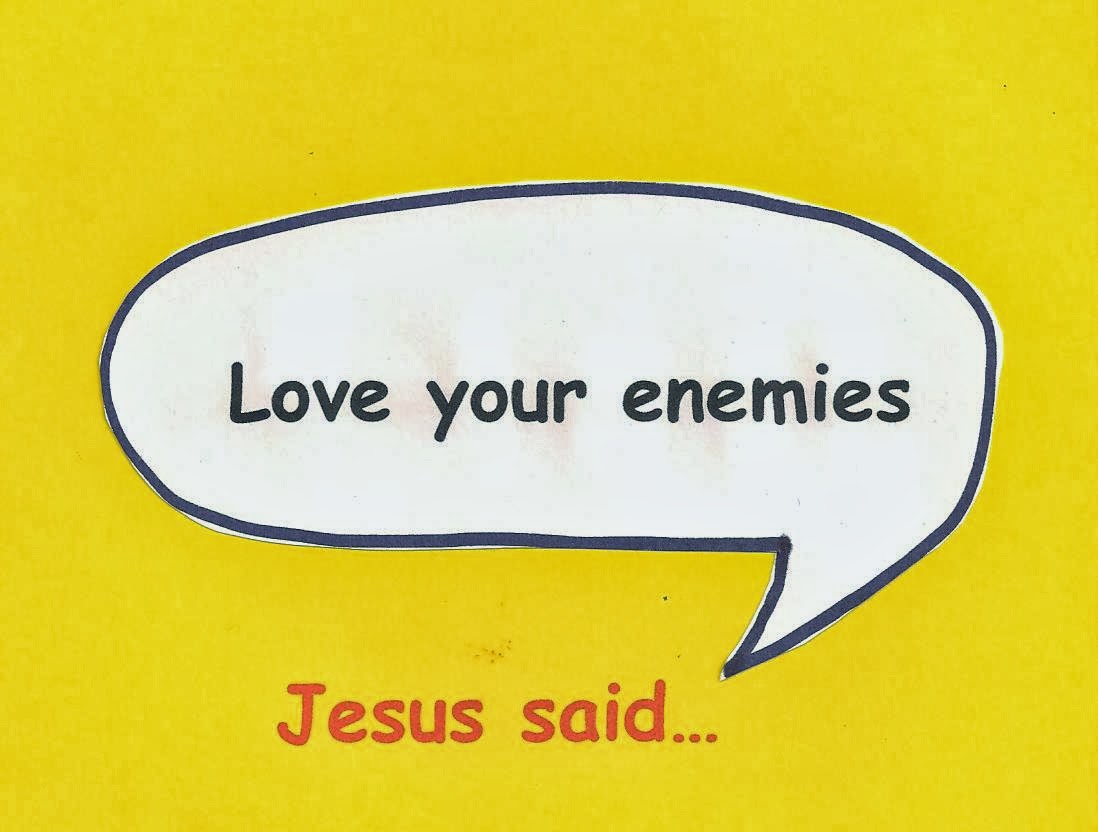
* Today’s “Jesus said” poster is
obvious. “Love your enemies.” As you add it to the other posters or put it
on display admit that it may be the hardest thing Jesus ever said.
* “Love you enemies.” Love here is a verb that means treat with respect. To most children love is a feeling or the way you act when you feel good about someone. Jesus’ teaching is that we should treat everyone, even people who are not nice to us, with respect. We must remember that no matter how they are treating us, they are God’s children and we need to treat them with respect. This takes some explaining!
* Several stories in which children refuse to participate in revenge are worthy sermon illustrations.

The
Story of Ruby Bridges, by
Robert Coles, tells the true story of a seven year old African American girl
who was escorted to school every day for months by federal marshals through
angry yelling white crowds as schools were desegregated in the American south. Each day she prayed asking God to forgive the
people who were yelling at her. Children
may have heard this story during Black History month at school as an example of
how hard it was to end segregation.
Revisit the story in worship as an example of a girl who chose to
forgive rather than retaliate. Check
this out from the public library if it available – it is Black History month.

The
Christmas Menorahs: How A Town Fought Hate, by Janice Cohn, is too long to read in worship (40
pages). Read it in advance and tell the
story in your own words during the sermon.
A hate group threw a rock through the bedroom window of a Jewish boy in
Billings, Montana. There was a menorah
lit in the window. In response the
children of the town drew menorahs to put in their own windows. The local newspaper printed a full page
menorah for other families to color in.
It was the community’s way of standing up to a bunch of bullies. The book includes the legend about the King
of Denmark wearing a yellow star when the occupying Nazis decreed that all Jews
must wear a yellow star. Available in
many public libraries.

Enemy
Pie, by Derek Munson, is a
picture book describing how Dad helped his son get rid of a neighborhood enemy
by baking an enemy pie. The secret ingredient
in the pie was that the son had to spend the entire afternoon with his enemy
being nice to him. Of course the enemy
was dispatched by becoming a friend. The
story could be told briefly in your own words during the sermon or could be
read in its entirety in 10 minutes.
While it is a bit simplistic, the story teaches a clear message and is
enjoyed by listeners of all ages. Though
the story is not widely familiar, I found several copies in the local public
library.
* If the children are sitting near you, hold out your hand and ask the child to slap your hand. After the slap act surprised and say, “You slapped me! I owe you one.” Then insist that the child hold out his or her hand. Gently slap it. Then say, “Oh no! Now you owe me a slap.” and offer your hand. Continue for several rounds. Then, stop yourself before you slap the child’s hand. “This could go on forever.” Announce that you are owed a chance to slap, but you are not going to take it. It is the only way you can stop the slapping. Thank the child who slapped with you. Then, note to everyone that this was a rather silly demonstration of something serious we face all the time. If someone hurts us, we want to hurt them back. If they call us a name, we call them one back. If someone breaks something of ours, we want to break something of theirs. If someone slaps or hits or kicks, we want to slap or hit or kick back. The problem with that is that everyone forgets who started it and keeps on hurting each other. Jesus tells us we have the power to stop all the hurting. Even if we deserve a chance to hit or kick or call names back when someone hurts us, we can refuse. It is one of the hardest things Jesus asks us to do. Note briefly that this doesn’t mean we should let anyone who wants to hurt us do so any way they can at any time they want. What Jesus says is that we should find another way to get things straightened out. Lots of time we need help to figure out that way. Jesus knows that and urges us to get all the help we can, but not to hit, slap, kick, hurt back.
* Sing about loving enemies
Before
singing the The Servant Song (“Brother, sister, let me serve you…”), give
worshipers a moment to make a silent list of the people it is really hard to
get along with. Then challenge them to
sing the song for those people. Even
read the first verse and point out that it is also the last verse – and not
easy to sing/pray for the people on our lists.
There
are two verses in Carolyn Winfrey Gillette’s hymn “Up On a Mountaintop” (words at Up On a Mountaintop) that
fit these verses especially well. Take
time to read them and illustrate them with everyday child or household situations
before inviting worshipers to sing the whole song.
If any hurt you, then you may resist,
But not with hatred or weapon or fist.
God's way is stronger than any you face;
Stand up and love them! And give them God's grace.
But not with hatred or weapon or fist.
God's way is stronger than any you face;
Stand up and love them! And give them God's grace.
Love those who hate you and pray for them,
too.
God's mercy reaches out far beyond you.
Seek, as God's people, God's wholeness each day
So you can witness to God's perfect way.
God's mercy reaches out far beyond you.
Seek, as God's people, God's wholeness each day
So you can witness to God's perfect way.


